

16 Jul How AI Powered Fitness Apps Are Revolutionizing Fitness | Features and Cost
Nowadays, AI powered fitness apps help users train smarter, remain consistent, and achieve their health goals faster. Now, fitness apps are more than just reps counters. An array of intelligent and adaptive health companions in AI workout apps is widely used today. Statista states that the global fitness app market, at present, anticipates a major $30 billion by 2026, reflecting strong consumer demand for personalized, tech-based wellness solutions. Allied Market Research has also reported AI powered fitness apps market growth at a CAGR of around 32% through 2030 on account of advancements in artificial intelligence and increased awareness of preventive health care.
Leading brands have already beat that curve. To name one, Freeletics uses AI-based technology to generate bespoke training programs that modify continually according to user feedback and real-time performance data. Fitbod is another favorite application which considers prior workout activities, muscle recovery periods, and available equipment to craft and propose well-optimized strength training programs. Nike Training Club also utilizes the power of AI-driven insights so it can make recommendations to the user based on their fitness level and goals.
Business owners are investing in custom mobile app development to stay competitive. AI offers customization, user retention, and instant health recognition. The fast-paced fitness & wellness economy needs all these. Building AI powered fitness apps has become a strategic decision rather than just a technocratic fad for fittech startups or established fitness brands.
Topics Covered
Types of AI Powered Fitness Apps
AI is revolutionizing fitness. Build your workout for you. Track moods, meals, and movements. AI powered fitness apps assists you in getting better sleep and smarter training. Fitness is made convenient for your lifestyle. Here’s exploring types of smart fitness apps.
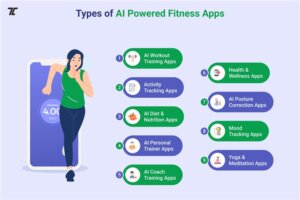
1. AI Workout Training Apps
The AI powered fitness apps requires training for building and modifying customized workouts based on users performance and goals. Over time, the apps are getting smarter and providing suggestions, such as strength, HIIT workouts, or cardio.
Features:
– Adaptive workout planning
– Smart rest & Rep adjustment
– Progress-based routine updates
2. Activity Tracking Apps
Activity tracking apps keep records of steps, calories, sleep, and behavior trends. These applications provide recommendations about goals and health insights using wearable and phone data.
Features:
– Real-time activity monitoring
– Goal-based daily tracking
– Behavior and trend analysis
3. AI Diet & Nutrition Apps
These apps use AI to customize meal recipes, analyze food intake, and recommend healthy dishes. They account for your daily activity to ultimately match your diet and fitness goals.
Features:
– AI meal generator
– Food recognition & logging
– Calorie & macro tracking
4. AI Personal Trainer Apps
These apps use AI applications to replicate personal trainers for workout guidance, adapting plans, and providing real-time feedback. A good bond of motivation keeps the user consistent.
Features:
– Voice-guided instructions
– Adaptive training logic
– Smart Scheduling & Motivation
5. AI Coach Training Apps
For athletes, AI powered coach training apps provide data-based coaching to enhance performance. They employ AI in analyzing workouts, form, and fatigue.
Features:
– Form correction & video analysis
– Performance goal tracking
– Sport-specific AI programs
6. Health & Wellness Apps
They take into consideration not only physical fitness but also sleep, stress, and lifestyle tracking. AI powered fitness apps provide personalized wellness programs for best wellness guidance to users.
Features:
– Wellness scoring
– Sleep & stress tracking
– AI habit recommendations
7. AI-Powered Posture Correction Apps
Using users camera, AI powered fitness apps will be identifies bad posture during exercise and it suggest real time solution for corrections. AI fitness apps widely helps to users for stay safe.
Features:
– Computer vision feedback
– Posture tracking & alerts
– Form improvement analytics
8. Mood Tracking Apps
Mood Tracking App tracks users mood patterns and suggests customized workout practice or mindfulness exercises for reducing stress/depression. Being fit today is less about repetitions or walking and much more about your movement, mindset, and motivation.
Features:
– Emotion detection via logs or sensors
– Smart journaling & insights
– Adaptive fitness based on mood
9. Yoga & Meditation Apps
Yoga & Meditation app customizes yoga flow and meditation according to users’ moods, flexibility, and wellness goals. AI powered fitness apps helps users to improving their wellness and fitness.
Features:
– Personalized sequences
– Users mood & flexibility input
– Breath and pose guidance
10. Femtech Apps
AI in femtech apps for women’s cycle-aware workouts, hormone tracking, and female-specific fitness goals; with a variety of exceptions, they help to tailor a routine to suit women’s health needs.
Features:
– Period & hormone tracking
– Cycle-sensitive training plans
– Fertility & pregnancy modes
How are AI Powered Fitness Apps a big deal?
AI is revolutionizing personal fitness systems. The AI powered fitness apps are a step above the traditional fitness apps in terms of intelligence, personalization, and catering to the user. They simply don’t track data; they use the data in real-time, adapting and providing a response to personalized experiences that keep end users engaged and motivated.
How AI converts generic fitness into genius:
Learns behavior and fitness goals
AI collects data continuously about the user with regard to their workouts, preferences, energy levels, and goals. This data is analyzed to build custom plans that change over time with the individual. The AI powered fitness apps creates a smarter workout based on the needs of your body.
Gives real-time posture correction
Through computer vision and motion tracking, these AI powered fitness apps set off to catch the posture in the actual time. Real-time feedback can be given to help fix your posture and prevent injuries. A gym trainer is in your pocket, observing, guiding, or even scolding every move you make.
Boosts engagement with smart nudges
AI can provide just-in-time reminders and motivate users through nudges and prompts. It could remind users that they’ve missed a workout or may suggest something fun to get their energy flowing. AI makes every little nudge anthropomorphic. This strategic interaction keeps them in the groove of consistency.
Reduces churn through adaptive feedback
When there is a plateau and a user loses interest, the AI goes in and assists in the modification, tailoring workouts and suggestions around performance or drop-off patterns. Thus, the adaptive feedback keeps the user engaged to less the chance they abandon the application.
Why are businesses investing in AI Powered Fitness Apps?
Business owners invest in AI powered fitness apps to provide personalized, data-driven health solutions that foster greater engagement with users, prompting higher retention and a lifelong association with the brand. These apps will sync with your wearables and adjust your workouts based on your sleep and mood. Essentially, these apps provide coaching in real-time via voice or chat methods.
Tracks progress and detects performance plateaus
Your fitness tracking app not only follows your workouts but also learns users routine fitness performance. At the time when the progress is limited, it sharpens itself to become smart and give you updates to help you break out of it. The user has at every moment in time help along the way. You are given a plan that grows with you.
Integration with fitness bands and wearables
These AI powered fitness apps partner with smart technology like Apple Watch, Samsung Watch, Fitbit, Fossil, Garmin, and Omega to capture high-fidelity health data layers of contextual information related to heart rate, sleep, recovery, and stress. This supports all the smarter real-time workouts, nutrition, and rest. With smartwatch app development, fitness enthusiasts will get a 360° health view for personalized fitness planning.
Adapts workouts to sleep and mood patterns
Fitness workout app used for tracking users’ mood, sleep, and energy, some variables here and there, considering possibly your voice or expression. The fitness tracking band holds in store some vital metrics for the AI to interpret, telling it just how you feel. If you are tired or if you did not sleep well, it targets softer activities such as yoga and walking. This balances the activities and keeps you on track, and helps you not to burn out.
Provides coaching through voice and chatbots in real time
Fitness coaching can be provided in real-time with feedback via voice or chatbots; the personal trainers are AI-based. Virtual assistants provide assistance with reps, instruct on correct form, and offer motivational support during a workout. Voice control allows your workout to become a true conversation; no tapping or swiping is required.
Trusted AI fitness app development company is now integrating AI by default.
What’s the Impact of AI Powered Fitness Apps?
AI fitness apps provide a very personalized workout regimen and a highly effective experience. The apps have real-time workout modifications to observe your form and keep you safe by providing instant consejos. These apps enjoy behavioral modeling and also nudging users on a daily basis to maintain high engagement. For the businesses, they are better in the retention of the app and yielding higher ROI in healthcare and fitness app development.
Offers hyper-personalised fitness journeys
One-size-fits-all programs just do not work. AI changes this by learning about your goals, body, and progress. Your fitness journey becomes 100% yours – wellness, workouts, and meal plans that evolve with you. Zero guesswork, zero fluff. Intelligent guidance that feels like it was designed personally for you.
Reduces injury through real-time tracking
Injuries can disrupt the whole rhythm of progress. These AI powered apps watch your form and posture in real-time via your sensors or your watch. They raise red flags whenever needed, guiding you on fixing the problem as though you had an ever-present personal virtual trainer inside your pocket, ensuring your safety and confidence.
Builds habits with behaviour modelling
Staying motivated is hard. AI makes this easier by learning about your habits and routines. It nudges you at the right time, celebrates the small wins with you, and so on. It is not going to push you hard; instead of AI understands how you move from one task to another throughout your day. That is what builds real habits.
Enhances ROI for healthcare app development
Who else but users? Businesses win with these applications too. AI brings in a special edge for apps: enabling retention, user satisfaction, and monetization. Lastly, for a healthcare brand putting investment into technology, it is giving a stronger ROI with real, lasting impact.
Increases app stickiness and daily active usage
AI brings users back for daily workouts that feel fresh, support when needed, and results when shown. Not merely tracking users, the AI interacts with users; that’s how applications stay relevant, useful, and part of a daily routine.
Market Trends of AI Powered Fitness Apps
Smart apps for fitness are intended for guidance, motivation, and integration into everyday life. People now demand that their workout app connect to wearables, respond to voice commands, and adapt in real time to their needs. Younger audiences look for tech-savvy experiences that can foster health from mind to body. This very shift is causing another wave of innovation in the fitness apps development.
AI fitness coach apps are booming
More people use fitness coach apps these days to reach their goals. An AI fitness trainer inside the app helps by generating intelligent workout plans, correcting form, and offering feedback in real-time. It is a kind of personal coach in the user’s pocket.
Integration with wearables is a given
Most workouts nowadays involve the use of a smartwatch or a fitness band. AI powered fitness apps of today easily sync with wearables tracking heart rate, sleep, steps, and more. With the rising trend in wearable app development, such seamless integration is no longer an option; it is what a user expects from any modern fitness experience.
Voice-activated AI-powered workout apps
The concept of working out with no barrier to touch is gaining traction among clients. Voice-enabled applications enable one to do a job, count reps, or change exercises without having to touch the display. It offers an easy atmosphere and motivation, more so during a home and gym ambiance.
Rising demand for Mobile App Development Services
With the increasing temperature rising for fitness tech, brands are now increasingly looking toward mobile app development services to provide opportunities for building smarter AI-driven experiences. Companies are searching for apps to engage, retain, and give value. That was the time when Fitness AI went into the limelight in the strategy.
Gamification & mental health features are raining
It’s an entirely new notion for fitness now, tied with performance. Users look for wellness apps that combine workouts with mood tracking, gamified targets, and stress management. In this move toward holistic health, individualized feel-good fitness is provided by AI.
Must-Have Features in AI Powered Fitness App?
Top AI fitness apps feel personal from the beginning, whereas the user is learned about what they need, and keeps them on track. All workouts are supervised, dynamically adjusted, timely reminders, and even correct the user if they do not maintain posture in proper form. Good entertainment flows with social support and fun challenges that reward progress.
User Profile & Goal Setup
Any good application requires users to input their fitness goals, preferences, and present state of health right from the start. Personalization happens here and is crucial for engagement in the long run. AI comes in handy to formulate ultra-personalized plans that evolve alongside the user.
Smart Workout Generator
By considering the goals, day-to-day activities, and fitness progress, the AI-generated code customizes workouts. Such routines ensure that the workouts stay interesting, relevant, and challenging but never draining. Users get to have adaptive workout plans in real-time.
Real-Time Progress Tracker
There is tracking of anything and everything, including calories burned or strength gained. Showing every bit of progress made to users while tracking it generates the motivation to take action and commit to the path on the dashboard itself.
Diet Plan Recommendations
Share meals and exercises. AI fitness app provides user-friendly personalized meal plans based on dietary activities,physical workouts and users goals. Nutrition is an experience. AI powered apps suggest a customized diet plan to individual as per their daily fitness insights.
Exercise Libraries
Clarity equals confidence. Offer vast libraries with video demonstrations, tips about proper technique, and instructional guides. Users can imbibe the correct form, thus making their workouts safe and effective.
Push Notification Reminders
Nudges at the right time maintain users’ consistency. Reminders for moving, drinking water, or taking a break aid in cementing habits. These notifications are designed to stay on task with the users, without being irritating.
Video-Based Form Checker
Camera-posture-analyzing AI. In real-time, the app corrects one’s posture and prevents injury; therefore, it builds confidence. Another fitness and gym application uses the camera and users’ wearable devices to analyze users’ fitness levels.
Social & Community Features
Advances can be shared, and users participate in challenges for support. An active community is known to motivate and retain users, making its foundation sticky with supportive users.
Gamification and Rewards
The gamification can hit some psychological triggers and allow one to really establish the habit without extra pressure.
Advanced Features of AI Powered Fitness Apps
The AI powered fitness apps do much more than just step and calorie counting. They make use of advanced technology that offers better user understanding, avoids injury, and creates highly personal experiences. Some of the most transformative features behind the future digital fitness ecosystem include.
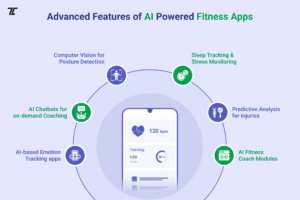
Computer Vision for Posture Detection
The camera becomes an improper form-checker in real-time. The computer vision algorithm was designed to look at angles and imprecise bending of limbs and alignments. Getting feedback to correct the posture of wrong working is different.
AI Chatbots for On-demand Coaching
The AI-based chatbot is positioned as a virtual fitness instructor working 24/7, taking real-time queries, viewing in-person exercises, amending minor details in workout programs, and keeping the user motivated. This makes the tool easier for public trainers to use. There is no friction in using the app in outdoor training at gyms.
AI-based Emotion Tracking & Suggestions
From inputs such as facial recognition, voice tonality, or biometric signals, Emotions-AI figures out the user’s state, whether energized, stressed, or tired, in order to sustain a good feeling for training for anyone.
Predictive Analysis for Injuries
Predictive analytics takes in historical activity and recovery patterns alongside form data, predicting if the user is going toward overtraining or will be at risk of receiving a consequent injury. Therefore, the app will be proactive in suggesting whether to take a rest or correct the workout form or train at a reduced level of intensity in case of forecasted risk.
Sleep Tracking & Stress Monitoring
Communicating with wearable devices, the AI will also look into sleep quality and stress indicators such as heart rate variabilities. This information will then be used to further tweak the training programs concerning the recovery status of users, as the users being mentally and physically tired are not being forced by the program.
Integration with AI Fitness Coach Modules
AI fitness coach modules gather all the tracked data, such as training, sleep, stress, mood, and nutrition, into a single intelligent system. This leads to a great coaching experience that morphs by day, guiding users with actionable insights conforming to their real-world needs and goals.
Third-party Apps Integration in AI Fitness Apps
Fitness platforms now rely on third-party integrations to enhance user experience and app functionalities. With these tools, one can add value and improve usability, ensuring that your app feels fully functional from day one.
Below are some important integrations that aid successful AI fitness apps:
Payment gateways
The integration modules for payment gateways like Stripe, Razorpay, and PayPal will provide services to enable users, straightforwardly, to buy subscriptions in the app, upgrades, or purchases using all world currencies, data-protected via end-to-end encryption.
Chat APIs (Twilio, Firebase)
Real-time messaging, video calls, and chatbot development provided by API providers such as Twilio or Firebase allow real-time chat interactions with either an AI coach or a human trainer, hence fostering user engagement and satisfaction.
Health data platforms
Connecting your app with Apple Health, Google Fit, or Samsung Health provides a smooth experience for syncing activity, heart rate, and sleep-related data, thus giving a seamless integration of health by taking real-time stats inside an app.
Nutrition APIs for food & calorie data
API services, like Spoonacular or Edamam, maintain a comprehensive list and database of foods. This allows the app to suggest meal plans and provide food tracking for the user. Nutrition integration takes the app a step further toward holistic wellness.
Music/Video streaming services
Embed spotify or youtube services so users can stream workout playlists or head into video workout guided sessions. The audio-visual will help while motivating the user through the workouts.
GPS and mapping services
Integrate Google Maps or Mapbox to allow real-time location tracking for running, cycling, or hiking; users map the route, distance, pace, and elevation. This feature provides outdoor enhancement to fitness activities.
With Mobile App Development services, you can ensure the third-party APIs are duly integrated, ensuring their secure and smooth operation across different platforms. They improve user experience and app performance.
Development Steps for AI Powered Fitness Apps
Developing an AI powered fitness apps is more than just coding. It needs strategy, proper tools, user-oriented design, and smooth AI integration. The following steps denote the full development journey toward delivering an intelligent yet user-friendly app that has a market of its own.
Conceptual Planning
Every successful app starts with a clear vision. During this stage, define application goals, target audience, core features, and business model. Planning includes competitor analysis and user research to ensure your solution addresses real fitness issues.
Choose Fitness App Types
Your choice of AI powered fitness apps development begins with deciding the various kinds it can be: an AI workout instructor, an activity tracker, nutritional coaching, or an all-in-one service. Deciding on the right kind of app helps focus feature-wise and therefore develops in line with the needs of your users.
Venture on the platform and tech stack
This is the platform decision to be launched on iOS, Android, or both. Then choose the stacks that will support AI integrations, scalability, and performance. Major ones are usually Python for AI, React Native for cross-platform, and Firebase or AWS for backend support.
Intuitive UI/UX Designing
User experience makes or breaks the app. Designers should create clean interfaces that are intuitive and feel personal and responsive. A good UX designer will keep a user engaged and confident throughout their fitness journey.
Develop Integrated AI modules
This is the real magic. ML models would provide individualized workout plans, real-time feedback, emotion detection, and progress tracking, besides integrating third-party APIs and wearable data for a deeper understanding of each user. Hire iPhone developers with strong experience in AI, data handling, and fitness integrations to get just the right app for your business.
Application Testing
Test for different kinds of devices, platforms, and user types. Usability, performance, data syncing, and AI accuracy must be kept at the forefront. An intuitive app that is completely free of bugs wins over user satisfaction and retention.
Launching Application
Launch the application on app stores with a marketing pack. Set social media and fitness influencers into overdrive to create a frenzy based on feedback from the beta testers. The correct use of app store optimization (ASO) will help in sustaining visibility for the app!
Support and Maintenance
The post-launch critical phase will include fixes every month or two, updates, fixes, improvements to AI models, enhancements to the features, etc., all to keep a customer interested and on goodwill.
Challenges in AI Powered Fitness Apps Development
Work smarter. Solve real-world problems. Designing and developing a fitness app is not just about workouts and wearing uppers. These present excellent development challenges in working with AI and users’ health data. Such problems can be overcome with good planning and the right team.
Complex AI training models
AI needs lots of training data. It takes time for training Fitness AI, thoroughly testing it, with all the right technologies. Poor datasets are going to produce poor AI suggestions anyway, which is why custom mobile app development ensures to have clear and trustworthy AI from the very first day.
Keeping User Data Private and GDPR Compliant
Stock user data protection. Fitness apps handle sensitive health data. Then you have laws to follow, such as GDPR, HIPAA, CCPA, PCI DSS, HITECH, and medical device legislation. This also entails tracking permissions for user data, encrypting the data, and giving control back to the users.
Real-time performance and battery optimization
Fitness apps should be light and fast. The battery drainage happens as AI features go on together with live tracking. Mobile app developers learn to optimize code and choose tools that can keep the app lean without draining the phone battery.
Building Secure API Connections
API must be secure and smooth. Always connect your wearables with a highly encrypted, secure API for financial transactions and payments. Weak API connections could expose your data. Hence, the teams work on having a secure integration with trusted platforms only.
Creating an inclusive dataset to prevent bias
AI needs to cater to everyone. Training an AI model on limited data can result in poor outputs for some users. Hence, a good app has an enriched training set spanning ages, body types, fitness levels, and genders.
Facing issues early on to make your app more safe, better, and more successful. This is where expert front-line custom mobile app development comes in. It provides you with all building confidence, risk resolution, and a faster launch.
How much cost for build an AI Powered Fitness Apps?
The price for building a AI powered fitness apps varies with the complexity of the app, the features you seek, and the platforms you wish to support for whether you are building a simple step tracker or an AI fitness coach app. Price of fitness app development cost depends upon the targets and features of your fitness apps and how advanced you want to implement them in.
Simple AI Powered Fitness Apps
Estimated Cost: $15,000 – $40,000
What it includes:
- Push notifications
- Sleep Tracking
- User sign-up & login
- Basic activity tracking
- Social Media Integration
- Workout library with videos
- Multiple device synchronization
- Goal setting & progress tracking
Best for Startups or MVPs wanting a lightweight app with core features and minimal AI.
Mid-Level AI Powered Fitness Apps
Estimated Cost: $45,000 – $1,00,000
What it includes:
- Geo Location
- Video Tutorials
- Nutrition tracking
- Analytics Panels
- In-app Purchases
- Security Protocols
- Online consultation
- Everything in the simple app
- Chatbot or messaging support
- Wearable devices integrations
- AI-powered workout recommendations
Best for brands that want to provide personalized fitness through smart automation and integration.
Complex AI Powered Fitness Apps
Estimated Cost: $1,00,000 – $1,50,000+
What it includes:
- Gamification
- Live streaming
- Video-on-demand
- Emotion/mood tracking
- AI-driven personal coach
- Gamification & social features
- Live coaching or video streaming
- Advanced analytics & predictive insights
- All basic and mid-level features included
- Multi-device sync and multilingual support
Best suited for established businesses and funded startups to build a fully scalable premium fitness platform with high user engagement and deep personalization.
The charges depend on the features, platform, as well as the complexity of a mobile application.
An expert fitness app development company gives accurate quotes.
Final Thoughts
AI powered fitness apps will be changing the upcoming future in the fitness & wellness. They solve user pain points with real-time, personalized solutions, from application development services to AI integration.
Choose the right fitness app development services to stay ahead from your competitiers. For more information stay tune with Tecocraft , your trusted development partner.


No Comments